NewSpace Manufacturing: How Satellite Constellations Are Rewriting Hardware Production Rules
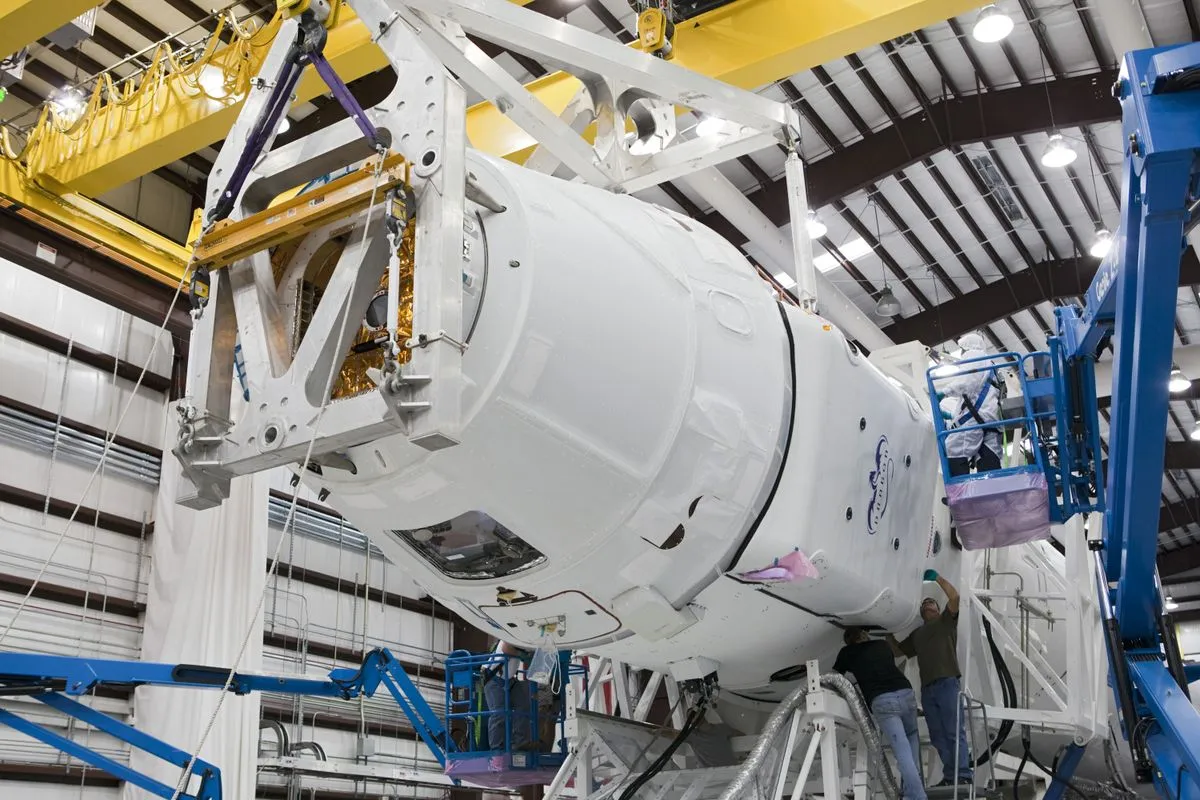
The space industry is undergoing a manufacturing transformation without precedent. For sixty years, satellites were built like Stradivari violins: handcrafted, one at a time, by master craftsmen using bespoke processes. Each satellite was unique, each assembly step was manual, and each unit took 2-3 years from order to orbit.
The constellation era has obliterated this model. OneWeb, Starlink, Amazon's Kuiper, and a growing number of European constellation programs require hundreds or thousands of satellites, delivered on timelines measured in weeks per unit rather than years. This shift from artisanal to industrial production is the most significant hardware manufacturing challenge in aerospace history.
The Scale Problem
The numbers tell the story. A traditional geostationary communication satellite costs €200-500 million and weighs 3,000-6,000 kg. A constellation satellite costs €500,000-2,000,000 and weighs 150-300 kg. But you need 600-12,000 of them.
This means the total manufacturing output of a constellation program exceeds the total output of the traditional satellite industry by an order of magnitude. The European space industry, which historically produced 20-30 large satellites per year, must now produce 20-30 constellation satellites per week.
This cannot be achieved by simply hiring more technicians and building more cleanrooms. It requires a fundamental rethinking of how space hardware is designed, manufactured, tested, and deployed.
Design for Manufacturing: The First Revolution
Traditional satellite hardware is designed for performance, with manufacturing considerations secondary. A solar panel deployment mechanism might use 47 different fastener types because each was optimized for its specific loading condition. A payload module might require 200 hours of manual cable routing because the cable paths were optimized for electromagnetic performance rather than assembly efficiency.
Constellation hardware must be designed for manufacturing from the first sketch. This means:
Part count reduction. Every part is a procurement item, an inventory item, an assembly step, and a potential failure point. Constellation satellites aggressively reduce part count through functional integration: combining multiple functions into single components. A structural bracket that also serves as a thermal bus and an electrical grounding path. An antenna reflector that also serves as a radiation shield.
Assembly simplification. Every manual operation is a bottleneck and a quality risk. Constellation designs maximize the use of automated assembly: robotic fastening, machine wire harnessing, automated soldering. Components are designed with features that facilitate automated handling: standard mounting patterns, self-aligning interfaces, and machine-readable identification.
Test simplification. Traditional satellite testing includes months of environmental testing, thermal vacuum cycling, vibration, EMC, for each unit. Constellation programs cannot afford this approach for every satellite. Instead, they qualify the design through extensive testing of early units and then apply reduced acceptance testing to production units, relying on manufacturing process control to ensure consistency.
The Production Line Challenge
Building a satellite production line is unlike building any other type of production line. The product is large (2-3 meters), fragile (sensitive to contamination, static discharge, and mechanical shock), and extraordinarily valuable (each unit carries a €500K-2M replacement cost plus launch cost).
The production environment must be cleaner than a hospital operating room (ISO Class 7 or better cleanroom), more precisely controlled than a semiconductor fab (temperature ±1°C, humidity ±5%), and more carefully monitored than a pharmaceutical plant (complete traceability of every component, process step, and operator).
European constellation manufacturers have drawn heavily on automotive production expertise, particularly from the German automotive industry, to design their production lines. The concepts of takt time, statistical process control, and lean manufacturing are being adapted for space hardware with appropriate modifications for the unique requirements of the domain.
The Supply Chain Transformation
A constellation satellite might have 2,000-5,000 components, sourced from 100-200 suppliers. At a production rate of 2-4 satellites per week, the supply chain must deliver 5,000-20,000 components per week with space-grade quality and traceability.
This is a radical departure from the traditional space supply chain, where components were procured in small quantities with extensive incoming inspection and qualification testing. Constellation programs must establish high-volume supply chains with embedded quality: quality built into the supplier's process rather than verified at incoming inspection.
The component qualification approach is also evolving. Traditional space components are qualified to military or space-grade specifications (e.g., MIL-PRF-38535 Class V for integrated circuits), with extensive radiation testing, life testing, and lot-level screening. Constellation programs use a mixed approach: space-grade components for critical functions and carefully qualified commercial components for less critical functions, with radiation mitigation handled at the system level through redundancy and error correction.
Configuration Management at Scale
Managing the configuration of hundreds of identical satellites introduces challenges that the traditional space industry has never faced. When every satellite is unique, configuration management is complex but manageable: each unit has its own configuration file. When you're building 600 identical satellites over three years, you need configuration management that handles:
Production variants. Even in a constellation, not all satellites are identical. Different orbital planes might require different antenna configurations. Software updates might be applied to later production units but not retrofitted to earlier ones.
Component substitutions. Over a three-year production run, component obsolescence and supply disruptions will force substitutions. Each substitution must be qualified and its impact on system performance documented.
As-built records. Each satellite must have a complete as-built record, every component, every process step, every test result, for the duration of its operational life (5-15 years). For a 600-satellite constellation, this represents millions of data points that must be stored, searchable, and retrievable.
Graph-based engineering platforms are finding a natural home in constellation manufacturing precisely because of this configuration management challenge. The ability to represent each satellite as a node in a graph, with relationships to its specific component set, test results, and deployment configuration, provides the traceability infrastructure that constellation programs require.
The European Opportunity
Europe is positioning itself as a serious player in the constellation manufacturing race. The EU's IRIS² sovereign connectivity constellation, Airbus's OneSat platform, and a growing number of European NewSpace startups are building constellation manufacturing capability across the continent.
For hardware engineers, this represents an extraordinary opportunity to work at the intersection of space technology and industrial manufacturing: combining the technical challenge of space-grade hardware with the efficiency demands of high-volume production. The skills required, design for manufacturing, production engineering, supply chain management, and statistical process control, are transferable across industries and increasingly valuable in a manufacturing landscape that is being reshaped by automation and digitalization.
The space factory is the future of aerospace manufacturing. And it's being built today.